Forecasting shared mobility in the RET app
From operator data to forecasts that travellers can use.
Industry deployment · SUM project · 2023–2026
The problem
A traveller arriving by public transport needs to know whether a shared vehicle will still be available for the last leg of their journey. Current availability alone cannot answer that question.
My contribution
As the sole model scientist for the SUM WP2 forecasting tool, I designed the forecasting framework and led model development. I also coordinated work across the delivery process: operator engagement, data-sharing arrangements, data handling, model integration, initial app functionality and user evaluation.
The project brought together CHECK, RET, TU Delft, Siemens Mobility and Infoplaza. Siemens Mobility provided the cloud API; Infoplaza connected the prediction service with RET’s journey planner. My role combined modelling ownership with coordination across those interfaces.
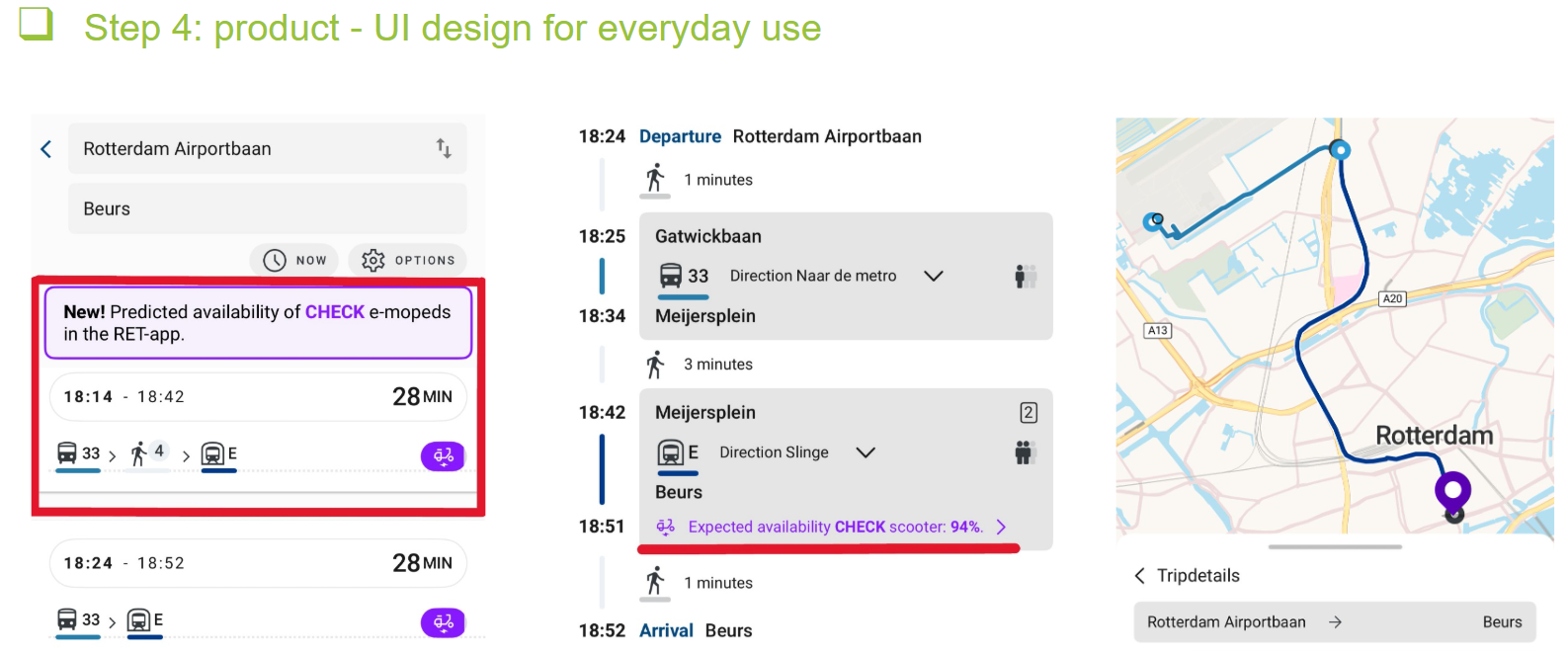
The forecasting service
The XGBoost-based pipeline uses temporal and contextual information to forecast pickup and drop-off demand and the probability that a vehicle will be available. Predictions cover 15-minute intervals up to 90 minutes ahead, with updates every 15 minutes.
From pilot to use
The service went live in 2025, initially at Rotterdam’s Beurs mobility hub, and subsequently expanded beyond the initial pilot. I also demonstrated a related forecasting application for Munich’s MVG mobility context.
I designed and analysed the customer survey distributed through the RET app. The final project brief reports 91 valid customer-survey responses; approximately 61% rated the feature at least moderately useful. These are self-reported survey findings, rather than a measured increase in ridership.
What this work involved
Forecasting was one part of delivery. Negotiating access to operational data, agreeing interfaces with platform partners, making probabilities useful in the app and collecting user feedback were all necessary to turn a model into a functioning service.