T-STAR
Probabilistic demand forecasting for sparse, high-frequency time series.
Published · Transportation Research Part C · 2026
The problem
At short time intervals, station-level shared-mobility demand is sparse and variable. Useful operational forecasts need to represent both the expected demand and its uncertainty.
My contribution
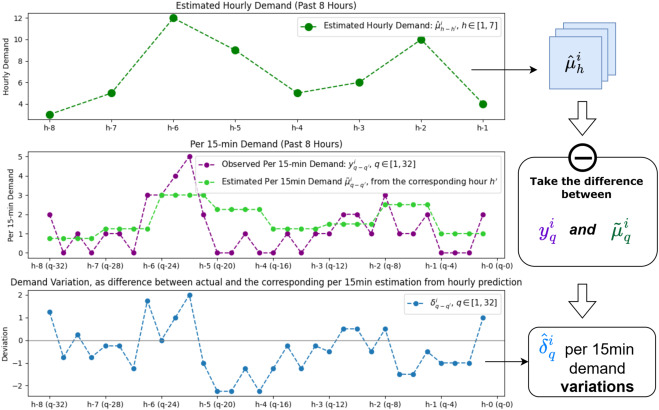
I developed T-STAR, a two-stage transformer framework that separates broad demand patterns from short-term fluctuations. The first stage models hourly patterns; the second incorporates recent local observations and demand variations in connected metro services to refine predictions at 15-minute resolution.
Evaluation
Experiments used Washington D.C.’s Capital Bikeshare data across 235 stations. Evaluation covered point and probabilistic forecast performance, spatial and temporal robustness, and a zero-shot transfer experiment in previously unseen service areas without retraining.
The study reports improvements over the evaluated baselines in both point and probabilistic forecasting. This is a research evaluation on Capital Bikeshare data; the separate RET deployment uses an XGBoost-based pipeline.
Paper and implementation
Jingyi Cheng, Gonçalo Correia, Oded Cats and Shadi Sharif Azadeh. T-STAR: A context-aware transformer framework for short-term probabilistic demand forecasting in dock-based shared micro-mobility. Transportation Research Part C: Emerging Technologies, 192, 105899 (2026).